
Freight rates are the prices shippers pay carriers or logistics providers to transport goods. In North American surface transportation, rates may apply to truckload, less-than-truckload, intermodal, or other freight services. They may be negotiated through longer-term contracts or established for individual shipments in the spot market.
The final cost of moving freight can include more than the base transportation rate. Fuel surcharges, accessorial fees, equipment requirements, service commitments, shipment characteristics, and lane conditions can all affect what a shipper ultimately pays.
Understanding where freight rates are today is important, but it is only part of the planning process. Shippers also need to understand why rates are changing, where capacity conditions may be headed, and what those changes could mean for transportation budgets, carrier contracts, routing guides, and service reliability.
This article focuses primarily on North American surface transportation, including truckload, less-than-truckload, and intermodal markets.
What Factors Influence Freight Rates?
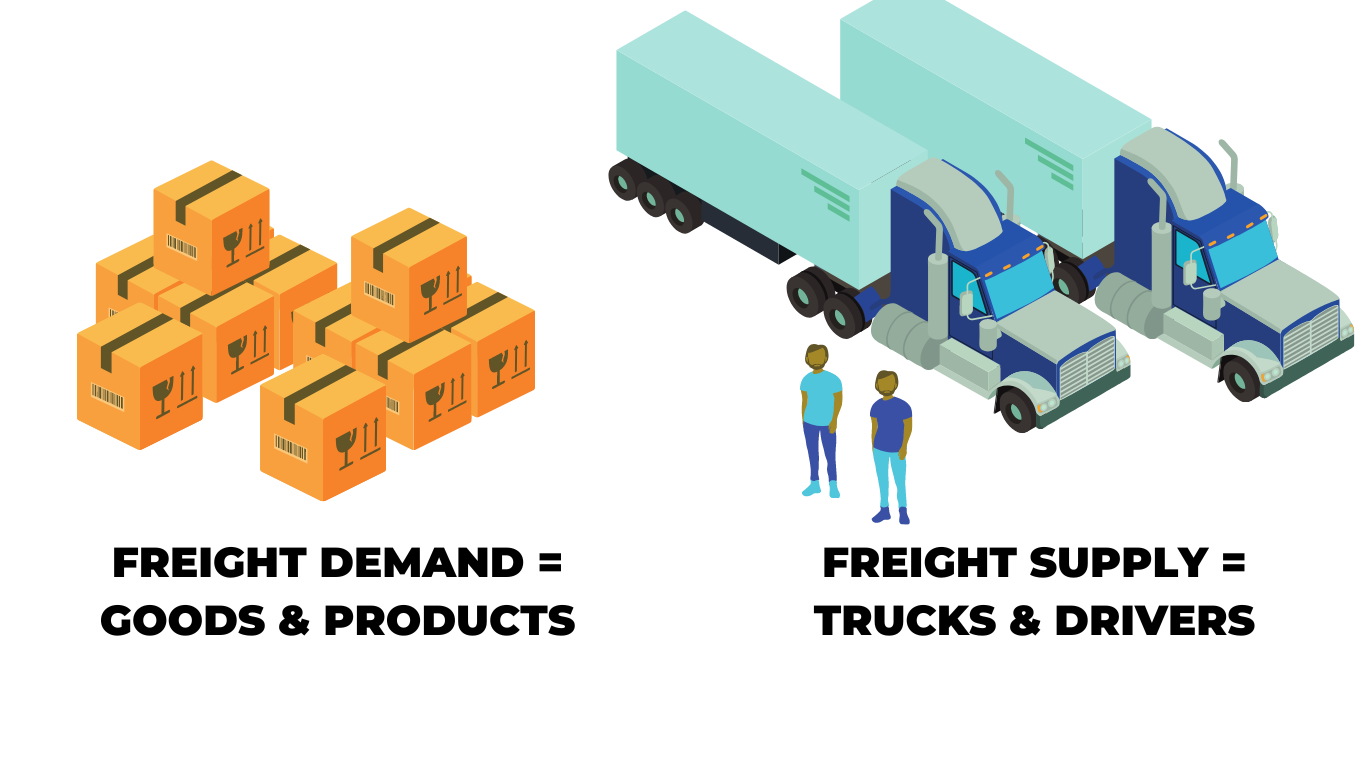
At the broadest level, freight rates are determined by supply and demand. Freight demand represents the amount of freight that needs to move. Supply represents the amount of carrier capacity available to move it.
When freight demand grows faster than available capacity, rates generally rise and shippers may have fewer carrier options. When capacity grows faster than demand, rates generally soften and shippers may gain negotiating leverage.
The actual rate for a shipment or contract is more complicated. Transportation teams should consider five major groups of factors.
Freight Demand
Consumer activity, industrial production, housing, construction, imports, exports, and inventory cycles all influence the amount and type of freight moving through the economy.
Retail freight is affected by consumer spending and inventory replenishment. Industrial freight responds to manufacturing, construction, energy, and capital investment. Imports can influence port, rail, intermodal, warehouse, and truckload volumes.
Freight demand can also vary by season, region, commodity, and equipment type. A broad national freight indicator may show modest growth while particular industries, lanes, or trailer types experience much tighter conditions.
Available Capacity
Capacity represents the carriers, drivers, tractors, trailers, and other equipment available to move freight.
Available capacity is influenced by:
- Carrier additions and exits
- Driver availability
- Fleet utilization
- Class 8 tractor production and replacement
- Equipment age and reliability
- Carrier profitability and access to capital
- Insurance and financing costs
- Regulatory and compliance requirements
- Private-fleet and for-hire fleet activity
Capacity can contract even when shipment demand is not accelerating. If carriers leave the market, fleets delay equipment replacement, or driver availability becomes constrained, rates and service pressure can increase before a broad increase in freight volumes becomes visible.
Shipment Requirements
Individual shipment characteristics affect the rate a carrier is willing to provide. Important considerations include:
- Distance
- Weight and dimensions
- Equipment type
- Commodity and handling requirements
- Pickup and delivery schedules
- Appointment requirements
- Shipment frequency
- Volume predictability
- Seasonal demand
- Service expectations
Freight requiring specialized equipment, expedited service, additional handling, or delivery into an imbalanced market will generally be priced differently from predictable freight moving through a dense carrier network.
Carrier Operating Costs
Carriers must account for the cost of operating and maintaining their fleets. These costs include:
- Fuel
- Driver wages and benefits
- Insurance
- Equipment
- Maintenance and repairs
- Financing
- Tolls
- Regulatory compliance
- Terminal and facility expenses
Changes in these costs can influence carrier pricing even when demand and capacity appear relatively stable. Shippers should evaluate whether a requested rate increase reflects broad market movement, carrier-specific costs, or a combination of both.
Service and Network Conditions
A lane’s operational fit also affects pricing. Carriers generally value freight that complements their network, provides predictable volume, reduces empty miles, and allows efficient equipment utilization.
Relevant considerations include:
- Lane density
- Backhaul availability
- Tender consistency
- Dwell time
- Facility performance
- Driver productivity
- Appointment flexibility
- Network balance
- Access to reload opportunities
A shipper with consistent freight, efficient facilities, accurate forecasts, and flexible operating requirements may be in a stronger negotiating position than a shipper whose freight creates delays, imbalances, or unpredictable equipment needs.
How Do Freight Rates Differ by Equipment Type?
Freight conditions do not move uniformly across every equipment category. Dry van, refrigerated, and flatbed markets serve different freight segments and can experience different demand, capacity, and seasonal pressures.
Dry Van
Dry van trailers carry packaged goods in fully enclosed trailers. Dry van is the largest and most standardized truckload equipment category and is closely connected to retail, consumer, manufacturing, and general merchandise freight.
Because of its size, dry van is often used to assess broad truckload market direction. However, national dry van averages can still conceal meaningful differences among regions and lanes.
Refrigerated
Refrigerated, or reefer, trailers transport temperature-sensitive products such as food, beverages, pharmaceuticals, and other perishable goods.
Reefer rates may be affected by produce seasons, food-production patterns, regional harvests, temperature-control requirements, sanitation requirements, and the availability of specialized equipment.
Flatbed
Flatbed trailers transport machinery, construction materials, steel, lumber, energy-related equipment, and other freight that may not fit inside an enclosed trailer.
Flatbed conditions are often connected to construction, infrastructure, manufacturing, utilities, and energy activity. The market may experience significant regional and seasonal differences.
Why Equipment Type Matters
Broad truckload averages provide useful market context, but shippers should evaluate each equipment market separately when establishing transportation budgets and negotiating contracts.
A shipper should not assume that a national truckload trend applies equally to dry van, refrigerated, and flatbed freight. Equipment availability, lane balance, seasonality, and freight demand may differ substantially.
How Do Contract and Spot Freight Rates Differ?
Contract and spot rates represent two different ways of purchasing freight transportation.
| Consideration | Contract rates | Spot rates |
|---|---|---|
| Typical use | Recurring and planned freight | One-time, overflow, or unexpected freight |
| Duration | Defined contract period | Individual shipment or short period |
| Pricing basis | Expected volume, lanes, equipment, and service requirements | Immediate market conditions and available capacity |
| Capacity | Usually includes an anticipated carrier commitment | Subject to current carrier availability |
| Stability | Greater budget predictability | Greater exposure to short-term volatility |
| Market response | Usually adjusts more gradually | Often responds more quickly to changes in supply and demand |
Contract rates are negotiated between a shipper and carrier for defined lanes, volumes, equipment, and service expectations. These agreements can improve budget predictability and support more stable carrier relationships.
Spot rates apply to freight purchased for an individual shipment or short period. Shippers commonly use the spot market for unexpected volume, rejected tenders, irregular lanes, overflow freight, or shipments not covered by existing contracts.
Many shippers use both markets. Contract carriers handle recurring freight, while the spot market supplies flexibility when shipment needs or available capacity change.
Spot rates can provide an early indication of a changing freight market because they respond more quickly to immediate supply-and-demand conditions. A sustained change in spot rates may eventually influence contract negotiations, but a national spot-rate average is not a direct substitute for a contract rate.
Contract rates must also account for lane characteristics, volume commitments, equipment requirements, service expectations, and the amount of capacity a carrier is expected to provide.
Current Freight-Rate Market Update
Updated Cass Freight Index® – August 2026 (July data)
Updated August 28, 2026
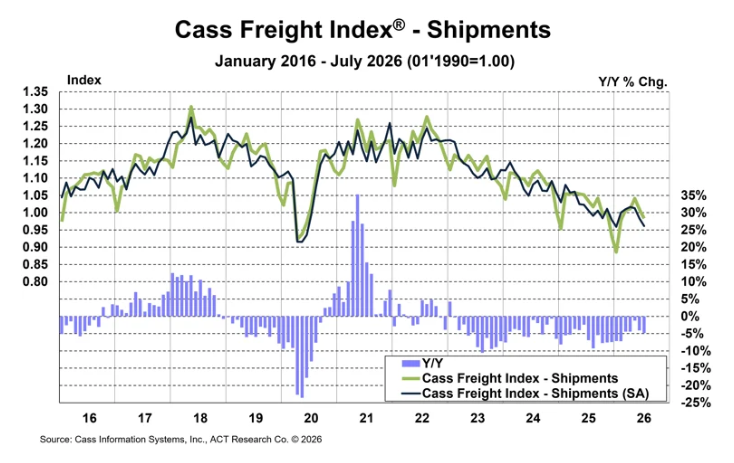
Freight Rates Remain Elevated as Capacity Constraints Persist and Contract Pricing Catches Up
Freight rates entered August 2026 well above year-ago levels, although spot conditions began to ease as the market moved into its third-quarter seasonal lull.
ACT’s August Freight Forecast showed dry van, reefer, and flatbed spot rates, excluding fuel, were 41% to 47% higher year over year in July. Aggregate contract rates were 17% higher year over year.
The movement in contract pricing indicates that the rate change has extended beyond short-term spot-market disruption and into shipper bids, contract renewals, and transportation budgets.
The Cass Freight Index®–Shipments component remains an important demand-side check on this rate story. ACT lowered its freight-demand outlook as higher interest rates, elevated fuel prices, slower job growth, and weak consumer fundamentals clouded the second half of 2026. Some freight is shifting from private fleets back toward the for-hire market, but current conditions are not being driven by a broad surge in shipment demand.
The distinction is important: freight rates remain elevated primarily because available capacity has contracted, not because freight demand has entered a broad-based expansion.
Spot Rates Continue to Lead the Market
Aggregate truckload spot rates remained above contract rates in July—by five cents per mile on a nominal basis and two cents on a seasonally adjusted basis.
Spot rates trading above contract rates indicate acute market tightness. Regulatory enforcement, an 18-month contraction in the Class 8 tractor fleet, limited equipment investment, and reduced driver availability have made it more difficult for the market to respond by quickly adding supply.
Spot conditions began to ease in late July and early August as seasonal freight demand softened and driver availability improved modestly. ACT expects the spot-to-contract spread to move from acutely tight toward tight during the third quarter as contract rates catch up and spot rates normalize.
Shippers should not assume that seasonal moderation will restore the purchasing leverage available during the previous downcycle. The market continues to operate with less supply flexibility, while regulatory constraints and higher equipment costs may limit how quickly capacity can respond.
Contract Rates Are Responding More Clearly
Aggregate contract rates, excluding fuel, increased eight cents in July to $2.50 per mile and were 17% above year-ago levels.
Contract rates historically follow spot rates by approximately five to six months. During the current cycle, shorter agreements and more frequent mini-bids have compressed that lag to only a few months. As a result, contract pricing is responding more quickly even as spot conditions begin to moderate seasonally.
The effect will not be uniform across every shipper or lane. Pricing changes will depend on:
- Lane balance
- Equipment requirements
- Routing-guide depth
- Carrier availability
- Volume consistency
- Service expectations
- The timing of the shipper’s procurement cycle
Transportation teams should monitor spot-to-contract rate spreads, tender acceptance, primary and backup carrier availability, lane-level capacity exposure, and the speed at which transactional pricing pressure enters routing guides.
Rate Conditions Differ by Equipment Type
Dry van spot rates, excluding fuel, increased 47% year over year in July to $2.41 per mile. Dry van contract rates increased 18% to $2.38 per mile. Conditions began easing in early August, but available equipment remained historically tight.
Reefer spot rates increased 41% year over year to $2.77 per mile, excluding fuel. Spot rates remained above contract rates for the third consecutive month, the first such period since February 2022. Contract rates increased 13% to $2.63 per mile. Extreme temperatures, specialized equipment requirements, and an historically old reefer trailer fleet continue to create capacity risk.
Flatbed spot rates remained near record levels at $2.92 per mile, excluding fuel, and were 41% higher year over year. Flatbed contract rates reached a record $3.09 per mile and increased 20% year over year. Data-center construction, related power-generation investment, energy activity, and specialized capacity continue to support pricing even as housing, cross-border freight, and construction seasonality soften.
These differences reinforce why shippers should not apply one national rate assumption to every mode, equipment category, region, or lane.
Capacity Remains the Primary Rate Driver
Available capacity remains the most important driver behind the current freight-rate trend.
ACT estimates U.S. highway truckload capacity was 1.8% smaller year over year in August after contracting for approximately 20 months. Driver availability has improved modestly as higher pay attracts drivers, but regulatory enforcement, driver-qualification requirements, and elevated equipment costs continue to restrict the supply response.
Tractor sales are beginning to move above replacement requirements, creating the potential for fleet growth. That response should slow the rate trajectory, but it will take time for additional equipment and qualified drivers to materially change market conditions.
For shippers, transportation costs and service constraints can intensify before shipment volumes provide an obvious warning. Routing-guide resilience, carrier redundancy, procurement timing, and modal flexibility are becoming increasingly important.
Transportation teams should:
- Reassess cost-to-serve by lane and mode
- Update labor, insurance, equipment, fuel, financing, and accessorial assumptions
- Review whether higher truckload rates improve the competitiveness of intermodal alternatives
- Rebuild primary and backup carrier coverage
- Identify lanes where rapidly adjusting contract pricing may create budget exposure
- Monitor tender acceptance and rejected-load activity
- Evaluate exposure to equipment- or region-specific capacity constraints
What Freight-Rate Data Should Shippers Use in Contract Negotiations?
Shippers should combine internal shipment history, existing contract costs, current market benchmarks, carrier-service performance, capacity indicators, operating-cost data, and forward-looking freight forecasts.
No single freight rate, index, or national average provides enough information to establish a defensible contract position.
| Data category | What to review | How it supports negotiations |
|---|---|---|
| Internal shipment data | Volume, spend, lanes, equipment, frequency, and seasonality | Defines the shipper’s actual transportation requirements |
| Existing contract data | Base rates, fuel schedules, accessorials, and escalation terms | Identifies the true incumbent cost |
| Market-rate benchmarks | Current spot and contract conditions | Tests whether proposed pricing aligns directionally with the market |
| Spot-to-contract spread | Direction and size of the difference | Indicates whether transactional pressure may enter contract pricing |
| Freight-volume indicators | Shipment, industrial, retail, import, and inventory trends | Evaluates the demand side of the market |
| Capacity indicators | Driver availability, carrier exits, tractor supply, and fleet utilization | Evaluates future carrier leverage and service risk |
| Carrier performance | Tender acceptance, rejected loads, on-time performance, and backup coverage | Balances quoted price against execution quality |
| Operating costs | Fuel, labor, insurance, equipment, financing, and maintenance | Evaluates the economic basis for carrier pricing |
| Forward forecasts | Expected rate, volume, and capacity direction | Informs timing, contract duration, and budget assumptions |
The appropriate negotiation position should reflect both broad market conditions and the shipper’s specific transportation network. National market data can indicate overall direction, while lane-level data helps evaluate individual carrier proposals and network exposure.
Freight-Rate Benchmarks and Forecasts Answer Different Questions
Freight-rate benchmarks and freight-rate forecasts both support contract negotiations, but they serve different purposes.
What Freight-Rate Benchmarks Tell Shippers
A freight-rate benchmark helps a shipper understand where the market is today or where it has recently been.
Depending on the source and level of detail, benchmarks can help answer:
- How does our current pricing compare with available market data?
- Are proposed rates directionally consistent with current conditions?
- Which lanes or equipment types require closer review?
- Has the market moved materially since our last bid?
- Where should we prioritize carrier discussions or targeted bids?
Benchmarks provide an important negotiating reference point, but they do not necessarily show where rates will be during the proposed contract period.
What Freight-Rate Forecasts Tell Shippers
A freight-rate forecast provides a forward-looking view of rates, volumes, capacity, and freight-market direction.
Forecasts can help answer:
- Are spot or contract rates expected to rise or decline?
- Could tightening capacity give carriers additional pricing leverage?
- Is current spot-market pressure likely to move into contract pricing?
- Should we negotiate now, delay a bid, or use a shorter contract term?
- How much rate or capacity risk should be included in the transportation budget?
- What conditions could require the agreement to be reviewed later?
Neither source should be used alone.
A benchmark establishes the current market reference point. A forecast helps determine whether that reference point is likely to remain valid over the life of the contract.
Shippers should combine both with their own lane-level pricing, shipment history, carrier performance, and service requirements.
Why Capacity Data Belongs in a Freight-Rate Negotiation
Freight demand is only one side of the rate equation. The other side is the amount of carrier capacity available to move that freight.
Rates can rise even when freight volumes are not growing rapidly if available capacity is contracting faster than demand. Carrier exits, driver availability, equipment costs, regulatory changes, and limited fleet investment can reduce the market’s ability to respond to shipper needs.
Transportation teams should evaluate capacity indicators alongside rate and volume data. Relevant indicators include:
- Carrier additions and exits
- Driver availability
- Class 8 tractor population and replacement trends
- Fleet utilization
- Equipment orders and production
- Load-to-truck ratios
- Tender acceptance
- Rejected-load activity
- Carrier operating costs
- Carrier financial conditions
- Regulatory changes affecting available drivers or equipment
Capacity data matters because the risk is not limited to price. Tightening conditions can affect tender acceptance, routing-guide performance, equipment availability, service reliability, and the cost of securing backup capacity.
A low contract rate provides little value if the carrier cannot consistently accept and service the freight.
Class 8 tractor data is especially useful for evaluating the broader capacity outlook. Tractor production, fleet replacement, equipment age, and carrier investment can help indicate whether future capacity is likely to expand, contract, or remain constrained.
July Class 8 orders increased 71% year over year, including a 103% increase in tractor orders. The sequential decline in orders primarily reflected limited remaining 2026 build availability rather than weaker demand. Retail sales also moved above estimated replacement requirements for the second consecutive month, suggesting that the equipment supply response is beginning.
These signals do not determine the appropriate rate for an individual lane. Instead, they provide context for the lane-level negotiation.
ACT Research connects freight-rate and volume indicators with commercial vehicle, carrier, economic, and capacity signals. This provides a more complete view of freight-market direction than shipment demand or current rate benchmarks can provide by themselves.
How Shippers Can Turn Freight Data into a Negotiation Strategy
Collecting freight data is only the first step. Its value comes from translating the information into specific contract, carrier, and network decisions.
Establish a Negotiation Range
Rather than entering a negotiation with one target rate, shippers should establish:
- A preferred target
- An acceptable market range
- A level requiring additional justification
- A threshold that triggers a rebid, modal review, or alternative carrier discussion
The range should reflect internal shipment history, current market benchmarks, expected operating costs, service requirements, and anticipated freight-market direction.
Segment the Transportation Network
A single market assumption should not be applied equally to every lane.
Shippers should distinguish between:
- Core and irregular lanes
- High-volume and low-volume freight
- Balanced and imbalanced markets
- Dry van, refrigerated, flatbed, LTL, and intermodal movements
- Stable lanes and capacity-constrained markets
- Standard freight and specialized service requirements
- Price-sensitive freight and service-critical freight
This segmentation helps transportation teams identify where consistent volume, operating flexibility, or multiple carrier options create negotiating leverage. It also identifies lanes where securing dependable capacity may be more important than obtaining the lowest initial rate.
Select the Appropriate Contract Structure
Market conditions should inform the length and structure of the agreement.
Possible approaches include:
- Annual contracts for stable, predictable freight
- Shorter agreements when market direction is uncertain
- Targeted mini-bids for lanes where pricing has moved materially
- Scheduled market reviews for longer agreements
- Indexed or adjustable pricing provisions
- Reopening clauses tied to defined market conditions
- A mix of contract and spot exposure based on lane characteristics
No contract length or procurement model is appropriate for every lane. The right structure depends on network needs, volume predictability, service requirements, expected market conditions, and tolerance for risk.
Balance Rate and Service Performance
The lowest quoted rate does not always produce the lowest total transportation cost.
Carrier proposals should be evaluated alongside:
- Tender acceptance
- On-time pickup and delivery
- Claims history
- Equipment availability
- Routing-guide compliance
- Communication and issue resolution
- Accessorial charges
- Spot-market exposure caused by rejected freight
- Availability of backup capacity
A carrier offering a slightly higher rate may create greater value if it consistently accepts freight, protects service, and reduces emergency spot-market purchases.
Prepare for Multiple Market Outcomes
Freight forecasts are not guarantees. They should be used to build and test several reasonable scenarios.
Transportation teams should consider:
- What happens if rates increase faster than expected?
- What happens if capacity tightens while freight demand remains uneven?
- What happens if rates remain stable?
- What happens if seasonal moderation continues and capacity begins to recover?
- What happens if demand weakens and carriers become more aggressive?
- Which lanes create the greatest budget or service exposure in each scenario?
Scenario planning helps determine where the shipper needs fixed pricing, greater flexibility, backup capacity, shorter contract terms, or review provisions.
Freight Contract-Negotiation Checklist
Before beginning a carrier negotiation or transportation bid, shippers should confirm that they can answer the following questions.
Internal Freight Profile
- Are lane volumes, shipment frequencies, and seasonal assumptions current?
- Have meaningful changes from the previous contract period been identified?
- Are equipment, handling, appointment, and service requirements clearly defined?
- Which lanes are core, irregular, seasonal, or service-critical?
Current Contract and Cost
- Have base rates, fuel surcharges, accessorials, and other charges been separated?
- Are carrier proposals being compared using the same assumptions?
- Is the actual all-in cost understood by carrier, lane, and mode?
- Are current rates being applied and invoiced correctly?
Market Conditions
- What are current spot and contract rates indicating?
- Is the spot-to-contract spread expanding or narrowing?
- Are freight volumes strengthening, weakening, or remaining stable?
- Is available capacity expanding or contracting?
- Do conditions differ materially by lane, region, mode, or equipment type?
Forward Outlook
- Where are rates, volumes, and capacity expected to move during the proposed contract?
- What assumptions are being made about freight demand?
- Could equipment, labor, regulatory, or carrier-cost pressures change the market?
- Which assumptions create the greatest budget or service risk?
- What conditions would require the agreement to be revisited?
Carrier Performance and Risk
- How consistently does each carrier accept tendered freight?
- Which carriers create the greatest rejected-load or spot-market exposure?
- Are service failures concentrated in particular lanes or periods?
- Does the carrier have the equipment and financial capacity to support its commitment?
- Is reliable backup coverage available for critical lanes?
Contract Strategy
- Is the proposed contract length appropriate for current and expected conditions?
- Should certain lanes use shorter agreements or targeted mini-bids?
- Are review, escalation, indexing, or reopening provisions necessary?
- Are volume commitments realistic?
- Does the proposal balance price, capacity assurance, and service performance?
- How will actual cost and carrier performance be measured after the contract is awarded?
A disciplined negotiation process should produce more than a lower quoted rate. It should help the shipper establish realistic transportation costs, secure appropriate capacity, protect service, and prepare for market conditions that may change during the contract period.
Frequently Asked Questions About Freight Rates
What Freight-Rate Data Is Most Important During Contract Negotiations?
Shippers should use internal lane and shipment history, current market benchmarks, spot and contract trends, carrier performance, capacity indicators, operating-cost data, and forward-looking forecasts.
Each source answers a different question. Together, they provide a more complete basis for evaluating proposed rates and contract terms.
Can Shippers Use Spot Rates to Negotiate Contract Rates?
Spot rates can indicate changing market balance, but they should not be treated as a direct replacement for contract rates.
Contract pricing also reflects expected volume, lane characteristics, equipment requirements, service commitments, and the amount of capacity a carrier is expected to provide.
What Is the Difference Between a Freight-Rate Benchmark and a Forecast?
A freight-rate benchmark measures current or historical market pricing. A freight-rate forecast estimates where rates, volumes, or capacity conditions may move during a future planning period.
Benchmarks help evaluate today’s market. Forecasts help assess whether those conditions are likely to persist throughout the proposed contract.
How Does Available Capacity Affect Contract Rates?
When available carrier capacity becomes tighter relative to freight demand, carriers generally gain pricing leverage and service risk can increase.
When capacity is abundant, shippers generally have more carrier options and greater negotiating leverage.
Should Shippers Use National or Lane-Level Freight-Rate Data?
Both can be useful, but they serve different purposes.
Broad market indices indicate overall rate and capacity direction. Lane-level data helps evaluate specific carrier proposals, operating requirements, and network exposure.
How Far Ahead Should Shippers Forecast Freight Rates?
The forecast horizon should cover the transportation budget and proposed contract term.
Plan Freight Negotiations with a Clearer View of What Comes Next
Use ACT’s forward-looking freight intelligence alongside your internal and lane-level data to strengthen transportation budgets, contract assumptions, and procurement decisions.
What are current freight rates?
As of April 2024, dry van spot rates are $1.53 per mile; DAT reefer spot rates are $1.83 per mile; and flatbed spot rates are $1.98 per mile. For further breakdown and analysis of current freight rates, check out ACT’s Freight Trucking Rates data tracker, updated monthly.
Freight rates have the power to make or break balance sheets, but what goes up must come down, and the rise and fall of freight rates is cyclical.
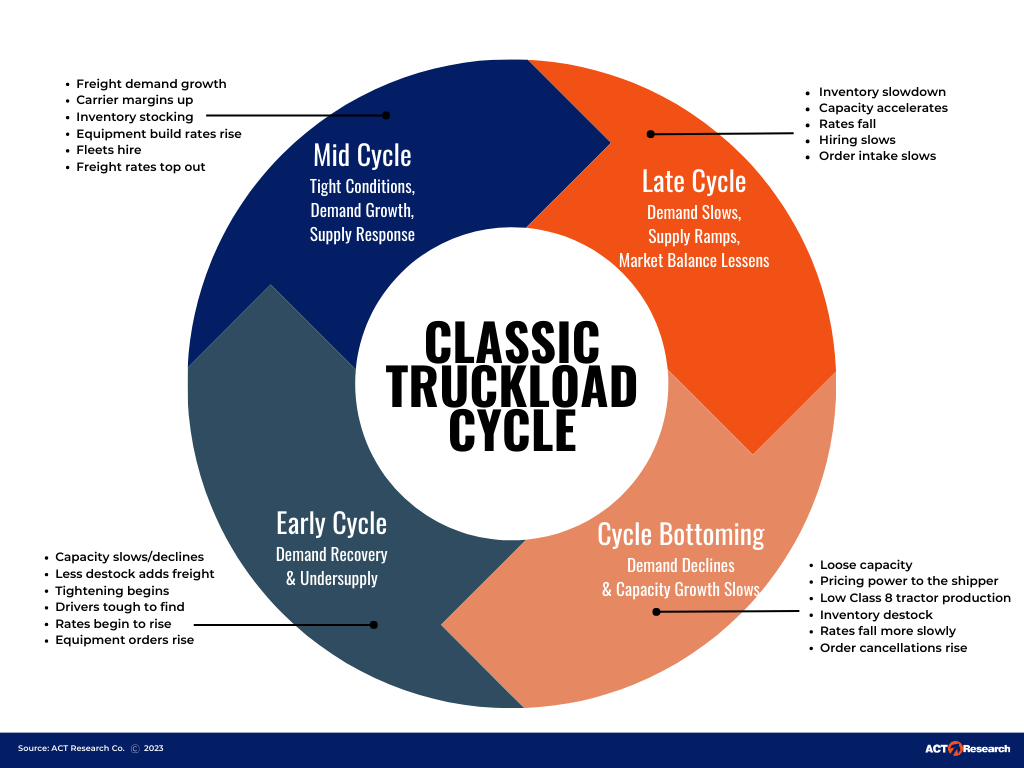
In the classic truckload cycle, there are four general phases, and freight rates are impacted based on which phase we’re in.
- Early phase: Rates rise
- Mid-phase: Rates plateau
- Late phase: Rates fall
- Bottom phase: Rates continue to fall, but more slowly
Rinse and repeat.
To see how freight rates are likely to change in the future, and for detailed analysis and forecasts for truckload, less-than-truckload, and intermodal, see ACT’s freight & transportation forecast.