Commercial Vehicle Market Intelligence for Dealers, Rental & Leasing Firms
Connect demand, inventory, used values, replacement timing, and residual-risk signals to stronger asset planning decisions.
ACT Research helps dealers, rental, and leasing firms understand the market signals shaping commercial vehicle demand, inventory strategy, used equipment values, lease assumptions, remarketing, and residual risk. With forward-looking forecasts, market data, and analyst interpretation, ACT gives your team a clearer view of the freight and equipment cycle so you can plan inventory, manage asset exposure, and make more confident portfolio decisions.
Get Transportation IntelligenceBuild inventory and asset strategy around a clearer market view.
Dealers, rental, and leasing firms operate at the intersection of new equipment demand, used equipment values, customer replacement timing, fleet utilization, and residual-risk exposure.
ACT helps your team connect commercial vehicle demand, freight conditions, used truck values, trailer trends, and broader economic signals into a forward-looking market view that supports smarter inventory, pricing, remarketing, leasing, and portfolio decisions.
- Inventory & Demand Planning: Track production, orders, retail sales, inventory, and segment-level demand signals to support better stock and sales planning.
- Used Value & Residual Risk: Monitor used truck pricing, resale trends, and replacement-cycle signals that may affect trade values, lease assumptions, and remarketing outcomes.
- Fleet & Portfolio Strategy: Connect freight conditions, equipment demand, utilization, and economic indicators to asset planning, rental strategy, and portfolio risk management.

"Without reliability, you have nothing; credibility goes out the window. At the end of the day, we found ACT Research to be the most reliable source in the marketplace."

Rusty Rush
Rush Enterprises, Inc.
Market intelligence for inventory, asset, and portfolio decisions
ACT Research helps dealers, rental, and leasing firms evaluate the market signals that influence inventory levels, customer demand, used values, residual risk, trade timing, and asset performance across commercial vehicle and trailer markets.
- Inventory Trends & Market Demand: Track production cycles, orders, backlog, retail sales, inventory levels, and segment demand to support stock planning and customer conversations.
- Used Vehicle Pricing & Sales Data: Monitor used truck values, sales activity, inventory, age, and mileage trends to support pricing, acquisition, trade, and remarketing decisions.
- Freight & Economic Context: Connect freight conditions, fleet profitability, equipment demand, and economic activity to leasing, rental, and dealer market strategy.
- Residual-Risk Signals: Understand how used values, replacement cycles, customer demand, and market timing may affect residual assumptions and portfolio exposure.
Who uses ACT dealer, rental, and leasing intelligence?
ACT supports teams that need a clearer view of equipment demand, used values, inventory conditions, customer behavior, and asset risk.
- Commercial Vehicle Dealers: Align inventory, sales strategy, customer conversations, and trade timing with current and future market conditions.
- Rental and Leasing Firms: Evaluate utilization, fleet mix, residual exposure, replacement timing, and asset strategy with stronger market context.
- Remarketing Teams: Track used values, transaction activity, inventory, and customer demand to support resale and redeployment decisions.
- Finance and Risk Teams: Use market-cycle intelligence to assess collateral values, lease assumptions, and portfolio exposure.
- Fleet and Procurement Teams: Monitor used values, equipment availability, and replacement-cycle timing for better acquisition and disposal decisions.
Forecasts and market intelligence for inventory and asset planning

U.S. Used Truck Price Forecast
Used truck value intelligence for collateral, residual-risk, and market-cycle analysis.
Used truck values can provide an important signal for transportation-sector health, fleet behavior, replacement timing, and collateral exposure.
ACT’s U.S. Used Truck Price Forecast helps investors, lenders, finance companies, and analysts evaluate used Class 8 tractor price trends by age and mileage group, with market context tied to freight demand, new truck availability, inventory, and macroeconomic conditions.
What It Offers
- Monthly used truck price forecasts for Class 8 tractors by age and mileage group
- Economic and market drivers affecting used truck prices
- Inventory, resale value, and replacement-cycle context
- Market intelligence for residual-risk and collateral-value analysis
Who Benefits
- Lenders and finance companies assessing collateral values and residual risk
- Investors and analysts using used truck prices as a transportation-sector health indicator
- Dealers, fleets, and remarketing teams evaluating inventory and resale expectations

North America Commercial Vehicle Outlook
Commercial vehicle forecasts for demand, production, and market planning.
ACT’s North America Commercial Vehicle Outlook helps manufacturers evaluate demand trends across Classes 4–8 vehicles and trailers over near- and long-term planning horizons.
It connects vehicle demand, economic indicators, fleet population trends, and market-cycle movement to help manufacturers align production, capacity, and strategic planning with future market conditions.
What It Offers
- Class 4–8 vehicle and trailer forecasts across 1-, 5-, and 10-year horizons
- Economic and industry drivers shaping commercial vehicle demand
- Fleet population, age, and replacement-cycle insights
- Market context for production, capacity, and demand planning
Who Benefits
- OEMs and suppliers aligning production and capacity with market demand
- Strategy, finance, and sales teams building market assumptions
- Investment and research teams tracking commercial vehicle industry performance
Discover the Data Driving Fleet Profitability

United States Used Trucks
Comprehensive Market Intelligence on North American Used Truck Classes 3-8
What It Offers:
- Monthly Sales and Price Trends: Detailed tracking of used truck sale transactions and pricing across Classes 3-8, giving insights into current market demand and valuation trends.
- Inventory Levels and Age Data: Analysis of used truck inventory levels, age distribution, and mileage, supporting informed buying and pricing strategies.
Who Benefits?
- Dealers needing insights into inventory demand to optimize stock and pricing.
- Fleet Managers planning replacements and valuing assets for future resale.
- Financiers and Investors seeking accurate valuation trends for lending or investment decisions.

North America Classes 5-8 Vehicles
Comprehensive Market Intelligence on North American Class 5-8 Vehicles
What It Offers:
- Monthly Production and Sales Data: In-depth coverage of monthly production, sales, and inventory levels for Class 5-8 trucks, providing critical insights into current and projected market conditions.
- Order Backlogs and Cancellation Rates: Detailed analysis of order backlogs, cancellation rates, and their implications for future demand, supporting accurate assessments of market momentum.
- Insights on Supply Constraints: Up-to-date information on supply chain pressures affecting Class 5-8 production, from parts shortages to labor availability, helping stakeholders manage and anticipate impacts on production timelines.
Who Benefits?
- OEMs and Tier 1 Suppliers optimizing production planning and adjusting to supply chain conditions based on total market data.
- Fleet Owners and Equipment Managers evaluating market trends to make informed decisions on fleet expansion, replacement, and capital investments.
- Logistics Companies and Freight Brokers monitoring equipment availability and market demand to plan capacity needs effectively.
- Investors and Analysts seeking data-driven insights into the performance and trajectory of the Class 5-8 market to guide investment strategies.

United States Trailers
Comprehensive Insights into the U.S. Trailer Market
What It Offers:
- Monthly Trailer Production and Factor Shipments: Timely reports on trailer production and factory shipments, providing a clear view of market demand, production capacity, and performance across the U.S. trailer industry.
- Backlog and Inventory Analysis: Detailed data on order backlogs and inventory levels, enabling stakeholders to assess production pipelines, capacity utilization, and inventory sufficiency.
- Order Cancellations and Net Orders: Insight into order trends, cancellations, and net order activity, supporting accurate assessments of demand shifts and overall market health.
- Segmented Market Insights: Breakdown of performance by trailer type (e.g., dry vans, reefers, flatbeds), offering targeted insights into each segment’s activity and growth trends.
Who Benefits?
- Trailer Manufacturers and Suppliers monitoring market demand and optimizing production planning to meet changing order levels.
- Dealers and Distributors aligning inventory with sales trends to maintain an optimal stock of high-demand trailer types.
- Fleet Managers and Equipment Buyers timing purchases based on production and inventory data to manage fleet needs and capital expenditure efficiently.
- Financial Analysts and Investors using trailer sales and production data as a barometer for economic and transportation sector trends, supporting data-driven investment decisions.
Updated August 28, 2026
Market Update - Dealers & Leasing
August 2026 Update
In a Supply-Constrained Market, Asset Providers Shift Toward Flexibility and Cost Management
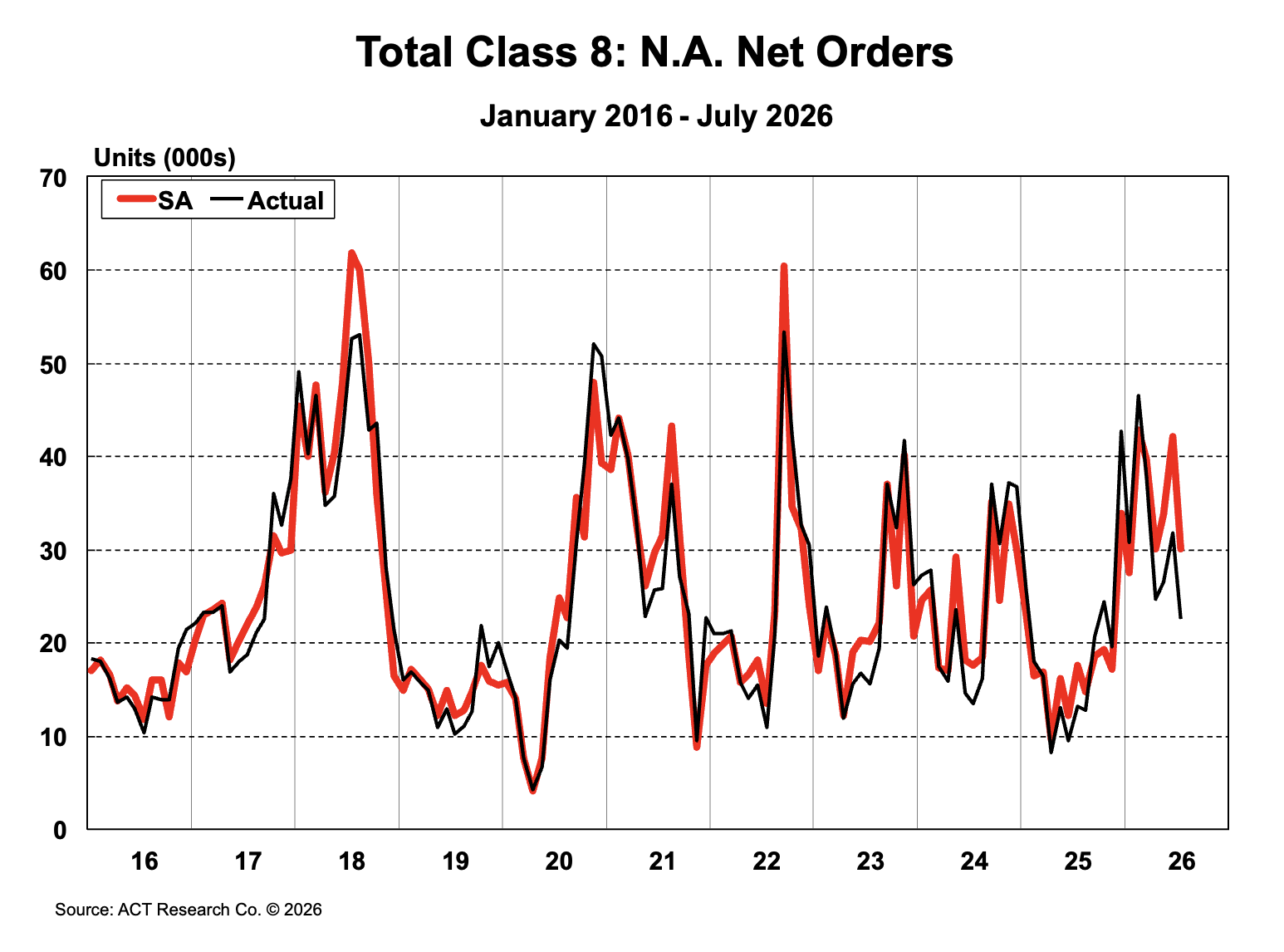
August brings a firmer but still disciplined environment for dealers, rental operators, and leasing providers. ACT’s latest reporting shows North American Class 8 orders increased 71% year over year in July, with tractor orders rising 103%. Stronger freight rates, constrained capacity, improving carrier profitability, replacement needs, and EPA 2027 planning continue to support fleet interest.
Orders declined 29% sequentially on a seasonally adjusted basis, but the decrease primarily reflected limited remaining 2026 build availability rather than a sudden weakening in equipment demand. ACT estimates that demand for the remaining production slots exceeds available capacity.
For asset providers, the signal is not broad expansion. It is a more constructive replacement market in which customers remain focused on cost, flexibility, uptime, and operating risk. Equipment prices, financing costs, insurance expenses, maintenance requirements, and regulatory uncertainty continue to influence purchasing decisions. Lease flexibility, uptime support, and trade-cycle planning are therefore becoming more valuable parts of the customer conversation.
Fleets Are Delaying Expansion, but Replacement Demand Is Strengthening
Broad fleet expansion remains measured, but the replacement environment is becoming more constructive. Dry van, reefer, and flatbed spot rates, excluding fuel, were 41% to 47% higher year over year in July, while aggregate contract rates increased 17%.
Driver availability has shown signs of stabilizing as higher pay attracts drivers, and tractor sales are moving above estimated replacement requirements. Even so, the Class 8 tractor fleet remains smaller than a year ago, available equipment remains tight, and regulatory enforcement continues to restrict the supply response.
These conditions are improving fleet confidence, but they do not eliminate the need for capital discipline. Customers are more likely to prioritize equipment that addresses aging assets, maintenance exposure, fuel efficiency, regulatory readiness, and operating reliability.
For dealers, rental companies, and leasing providers, this supports a healthier sales pipeline without necessarily creating an indiscriminate buying cycle. Leasing and rental structures may be especially attractive to fleets that need newer equipment, bridge capacity, or regulatory flexibility but remain reluctant to assume full ownership, financing, and residual-value exposure.
Used-truck conditions should remain part of these discussions. July same-dealer Class 8 retail sales declined 2.5% sequentially but increased 45% year over year. Average retail prices fell 4% during the month to $60,986 and were 2% below year-ago levels.
Strong transaction activity alongside softer pricing indicates that replacement and trade activity are improving without producing uniform value appreciation. Elevated exports are also removing used tractors from the domestic market. Asset managers should distinguish between improving equipment turnover and a broad, sustained increase in used-equipment values.
Leasing and Sales Strategies Must Reflect a Risk-Managed Mindset
Fleet buyers are balancing replacement requirements against cost volatility, regulatory timing, equipment availability, and uneven freight demand. This creates an opportunity for asset providers that can align equipment solutions with customer cash flow, operating needs, and risk tolerance.
That may include:
· Structuring lease terms with renewal, purchase, conversion, or upgrade options
· Bundling maintenance, uptime, and telematics support where appropriate
· Incorporating EPA 2027 engine strategies and fuel-efficiency considerations into longer-term agreements
· Providing structured trade-in pathways for aging or maintenance-intensive assets
· Matching payment structures and equipment commitments to customer utilization expectations
Demand is likely to be strongest where the replacement rationale is clearest. Tractor sales increased 8.2% year over year in July and moved above estimated replacement demand for the second consecutive month. Day cabs and regional tractors may benefit from tighter freight capacity, changing network requirements, and improving LTL conditions.
Vocational equipment continues to receive support from infrastructure, utility, energy, commodity, construction, and data-center-related investment. July vocational Class 8 orders increased 18% year over year. However, elevated vocational inventories require careful differentiation between end-user demand and available dealer stock.
Long-haul tractor interest is also improving, but elevated total cost of ownership and uneven broader freight demand continue to limit expansion behavior. Asset providers should evaluate customer profitability, fleet age, utilization, trade position, and financing capacity before assuming that stronger order activity will translate into fleet growth.
Inventory Management Is Critical
Inventory and asset strategy remain central in a market where demand is improving but still uneven. Class 8 backlogs ended July at 182,817 units, equal to approximately 8.9 months of production on a seasonally adjusted basis and well above the historical average.
Third- and fourth-quarter build plans moved modestly lower as manufacturers assessed how quickly production could ramp. For dealers, lessors, and rental operators, elevated backlogs improve forward visibility but do not guarantee evenly distributed customer demand or delivery timing.
Class 8 inventories ended July at approximately 83,100 units. Tractor inventories are comparatively healthy following production reductions in 2024 and 2025. Vocational inventories remain significantly above historical norms, creating greater pricing, aging, and carrying-cost risk in those applications.
Medium-duty inventories also remain elevated. ACT raised its 2026 Classes 5–7 production forecast materially even as existing stocks remained high. Asset providers should monitor retail conversion, inventory-to-sales ratios, body-builder throughput, and application-specific demand before expanding commitments.
Trailer conditions have become more constructive. July net orders increased 16% sequentially and 94% year over year, while backlogs were more than 13% above year-ago levels. The backlog-to-build ratio reached five months but remained below its long-term average, and cancellations improved to 0.7% of backlog.
For trailer asset providers, replacement requirements, fleet age, maintenance exposure, and stronger freight economics support demand. Equipment pricing, tariffs, materials costs, financing conditions, and segment-level demand still require close attention.
Relative strength should be monitored in:
· Day cabs and regional tractors
· Sleeper tractors with clear replacement and utilization support
· Dry vans serving tightening truckload networks
· Refrigerated equipment where fleet age and specialized-capacity constraints support replacement
· Vocational units tied to utilities, infrastructure, energy, commodities, construction, and data-center investment
· Flatbeds and specialized trailers serving project-related freight
Vocational units held in elevated dealer inventories, weaker cyclical applications, and assets tied to less resilient freight segments may still require active pricing, targeted deployment, and disciplined rotation.
Inventory Discipline Remains Strategic
August reinforces that the commercial vehicle market is improving, but asset providers still need to manage exposure carefully. Stronger freight rates, constrained capacity, improving carrier profitability, and replacement requirements are supporting customer engagement. At the same time, financing costs, equipment prices, operating expenses, and uncertainty surrounding EPA 2027 continue to shape purchasing behavior.
The EPA’s proposed rule retains the underlying low-NOx technology requirements while introducing nonconformance penalties and potentially extending warranty and useful-life requirements to 2030. The structure could produce a more staggered transition, making equipment flexibility and manufacturer-specific product strategies increasingly important.
Key focus areas include:
· Aligning inventory and asset allocation with confirmed customer demand
· Separating replacement activity from actual fleet expansion
· Limiting idle exposure in weaker applications or regions
· Managing elevated vocational and medium-duty inventories
· Building compliance and equipment flexibility into customer agreements
· Incorporating fuel efficiency, maintenance, utilization, and uptime into sales and leasing strategies
· Using used-equipment transactions, exports, and customer financial health to manage residual-value risk
· Monitoring order conversion, production timing, retail sales, and cancellations before expanding commitments
As replacement activity strengthens, asset providers that offer flexible, reliable, and cost-aware solutions will be better positioned to support customers while protecting utilization, margins, and residual values. The market is becoming more constructive, but the advantage will accrue to providers that respond selectively rather than treating stronger orders as evidence of broad-based expansion.
Freight's supply-driven upturn: How long will rates rise?

Why dealers, rental, and leasing firms choose ACT Research
Inventory, leasing, rental, and asset decisions depend on more than one market signal. ACT combines direct market data, disciplined forecasting methodology, analyst expertise, and long-standing industry relationships to help teams understand the freight, equipment, and used value signals shaping market performance.
- Proprietary commercial vehicle, freight, trailer, and used equipment market data
- Forecast methodology built on decades of market-cycle experience
- Analyst interpretation that connects demand, inventory, freight, and asset-value signals
- Market intelligence used by dealers, rental, leasing, finance, fleet, and investment teams
- Trusted perspective for evaluating inventory, residual risk, and replacement-cycle timing
Market guidance for inventory, leasing, and asset decisions
ACT helps dealers, rental firms, and leasing providers understand the market signals that affect equipment demand, customer replacement timing, used values, residual risk, and portfolio performance.
Our intelligence supports teams responsible for sales, finance, inventory, leasing, rental, remarketing, risk management, and executive planning with a clearer view of freight conditions, commercial vehicle demand, production trends, used truck values, trailer markets, and regulatory timing.
With ACT Research, dealer, rental, and leasing teams can:
- Make stronger inventory decisions with current market analysis and forward-looking commercial vehicle forecasts.
- Evaluate residual and asset risk with better visibility into used truck values, replacement timing, and market-cycle movement.
- Connect freight conditions to customer demand by understanding how rates, fleet profitability, and capacity conditions may affect equipment purchasing behavior.
- Support remarketing and trade strategy with intelligence on used values, inventory, transaction activity, and resale timing.
- Spot risks and opportunities earlier across freight, economic, regulatory, equipment, and used-market signals.
- Support financial and executive planning with market assumptions your team can defend.

Ready to connect market signals to your next inventory or asset decision?
ACT helps dealers, rental, and leasing firms connect commercial vehicle demand, freight conditions, used equipment values, trailer activity, and regulatory timing to stronger inventory, leasing, rental, and portfolio planning decisions.
Whether your team is managing stock levels, evaluating trade timing, setting lease assumptions, monitoring residual risk, planning remarketing strategy, or preparing for customer demand shifts, ACT can help you develop a clearer view of what comes next.
Questions about the right intelligence for your inventory or asset decisions?
ACT can help you identify the forecasts, market data, and analyst perspective that fit your inventory, leasing, rental, remarketing, or portfolio-planning needs.