
Freight Market Intelligence for Brokers
Navigate freight with confidence
ACT Research helps freight brokers understand where rates, capacity, and market conditions are headed — and what those signals may mean for pricing strategy, customer conversations, and margin protection. With forward-looking freight forecasts, market data, and analyst interpretation, ACT gives brokerage teams a clearer view of the freight cycle so they can advise shippers with confidence and make better decisions before the market shifts.
Get Transportation IntelligenceTurn freight market movement into stronger brokerage decisions.
Brokerage success depends on more than today’s spot rate. Rate direction, carrier capacity, shipper behavior, freight demand, equipment supply, and broader economic conditions all affect margin, service, and customer trust.
ACT helps brokers connect these signals into a forward-looking market view that supports pricing discipline, carrier strategy, customer advisory value, and more confident planning.
Rate & Margin Planning
Understand spot and contract rate direction so your team can price with more discipline and protect margin as the market changes.
Carrier Capacity Strategy
Track capacity conditions, Class 8 tractor supply, and carrier market dynamics to better anticipate coverage challenges and service risk.
Shipper Advisory Value
Use forward-looking market intelligence to help customers understand what is changing, why it matters, and how it may affect their transportation strategy.
Market Risk Awareness
Identify freight, economic, equipment, and regulatory signals that could shift pricing, capacity, or service expectations.

Forecasts your brokerage team can use with confidence.
ACT Research’s 2024 forecasts for the Cass Truckload Linehaul Index® were 98.8% accurate on average over the past 18 months, and were spot on from 13 months out.
ACT’s freight forecasts help brokers evaluate where rates, volumes, and market conditions may be headed — and how those changes may affect shipper expectations, pricing strategy, carrier relationships, and margin.
When your team needs to support customer conversations or internal planning with a credible market view, ACT provides forward-looking intelligence backed by data, methodology, and analyst interpretation.
See freight demand, rate direction, and capacity shifts before they pressure margin.
Logistics brokers need to anticipate market shifts, advise shippers, secure reliable capacity, and protect profitability in changing freight conditions.
There are many sources that show what has already happened in freight markets. ACT helps brokers look ahead by connecting freight demand, rate direction, carrier capacity, equipment supply, economic indicators, and analyst perspective into a more complete view of the freight cycle.
With ACT Research, your team can use:
- DAT spot and contract rate forecasts to evaluate dry van, refrigerated, and flatbed rate direction.
- Cass-powered freight volume and mode insights to understand broader freight movement across truckload, LTL, and intermodal markets.
- Class 8 tractor forecasts to understand active tractor capacity and future equipment supply.
- Freight-weighted economic indicators to connect consumer demand and economic activity to freight market conditions.
- ACT analyst interpretation from a team with more than 250 years of combined industry experience.

Three strengths behind ACT’s broker intelligence
ACT’s freight and brokerage-focused intelligence combines proprietary data, disciplined methodology, and experienced analyst interpretation to help brokers understand not only what changed in the market, but what it may mean for pricing, capacity, margin, and customer strategy.
- ACT Proprietary Data
- ACT Methodology
- ACT Human Intelligence

ACT Proprietary Data
ACT’s market view begins with direct visibility into the freight, equipment, and commercial vehicle signals that shape transportation planning decisions.
By tracking market indicators across commercial vehicles, freight, trailers, used equipment, and broader economic activity, ACT helps customers understand what is changing, how signals connect, and what those shifts may mean for the road ahead.

ACT Methodology
ACT’s forecasting methodology is built on decades of market-cycle experience, industry relationships, historical data, and disciplined analysis.
We connect freight demand, equipment supply, economic activity, production trends, used equipment values, regulatory factors, and customer behavior to help customers evaluate the market with a balanced, forward-looking view.

ACT Human Intelligence
ACT’s analysts bring deep experience across freight, equipment, commercial vehicle, used truck, trailer, regulatory, and economic markets.
We do not simply report the data. We interpret what market signals may mean, how they connect across the transportation cycle, and what decisions they may help inform.
Our work is your competitive advantage

Predictive Insights
Understand where freight rates, volumes, and capacity conditions may be headed so your team can prepare before market changes affect pricing, utilization, and profitability.

Strategic Planning
Use forward-looking market analysis to support decisions about customer mix, fleet size, replacement timing, capital investment, and long-term growth strategy.

Risk Mitigation
Identify market, capacity, economic, and equipment-cycle risks earlier so your team can build more resilient plans and avoid being caught off guard.

Operational Efficiency
Connect supply-demand conditions, rate trends, and equipment signals to decisions around network balance, service commitments, lane strategy, and asset utilization.
ACT Research is one of the best resources you can have to make those accurate forecasts. ACT has allowed us to take what we know from our 20-plus years of business in freight brokerage and allowed us to quantify those feelings and allowed us to set the course for the business that we felt was appropriate but gave us the data to back those decisions and made us smarter in the process as well.

Christopher Thornycroft
Redwood Logistics
Updated September 28, 2026
Market Update - Brokers
September 2026
Softer Spot Rates Require a Closer Look at Fuel, Capacity, and Customer Pricing
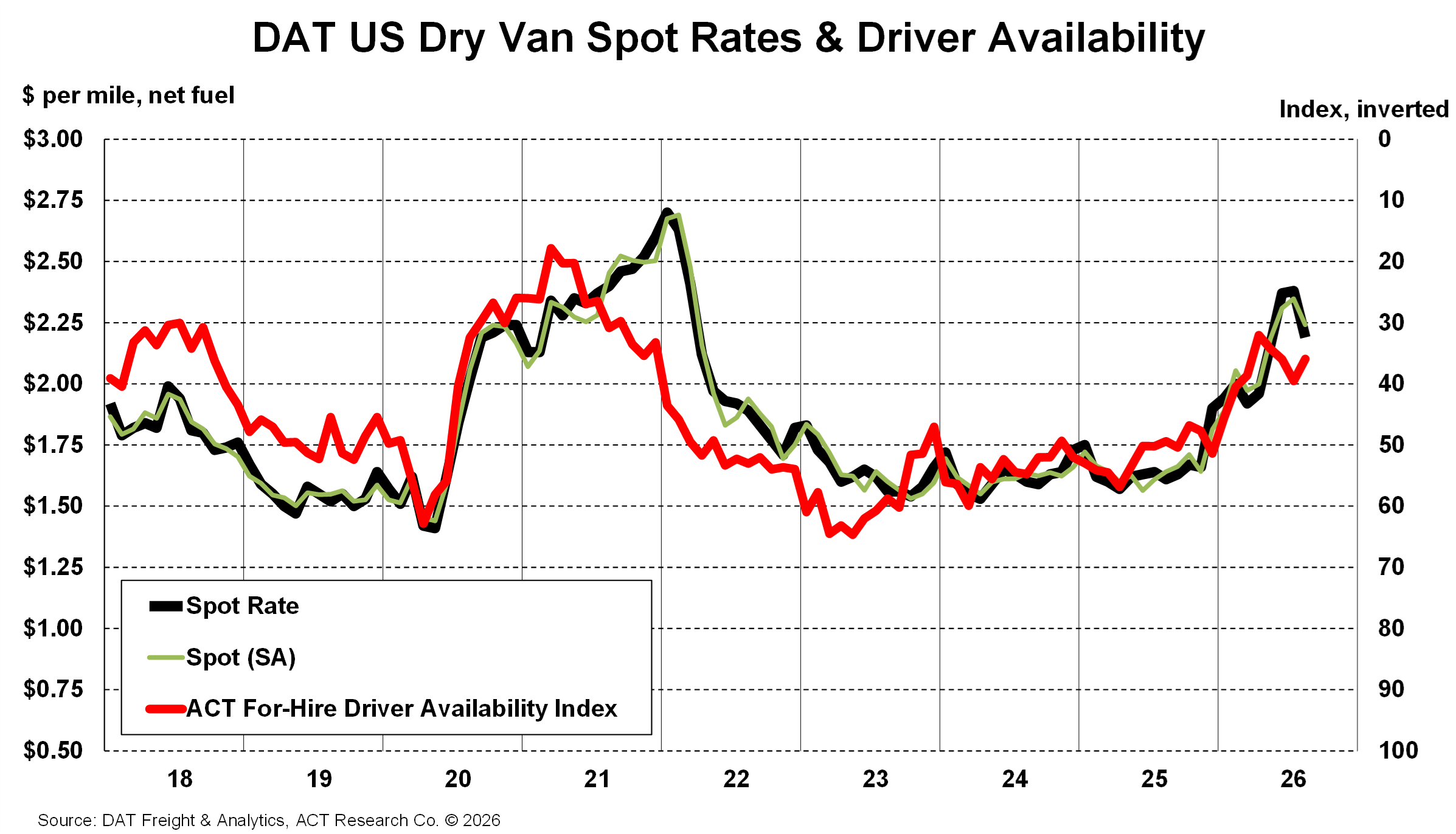
September’s freight market presents brokers and 3PLs with a more complex pricing environment. ACT’s latest Freight Forecast identifies broader improvement in demand, while capacity remains constrained. August spot rates declined across the major trailer types when measured excluding fuel, but that movement does not establish a broad return of excess truck availability.
Seasonal easing contributed to softer spot pricing. Higher diesel costs also reduced carriers’ net-fuel revenue where all-in prices did not fully recover the increase. For intermediaries, the implication depends on how customer pricing, carrier purchases, and fuel treatment interact within each account.
National Benchmarks Need Lane-Level Context
A decline in a national spot benchmark may create buying opportunities on some lanes without producing the same result across an entire customer network. Equipment requirements, regional demand, shipment timing, and carrier availability continue to influence the cost of coverage.
Contract markets also moved differently in August. Reefer contract rates increased, dry van rates held steady, and flatbed rates eased slightly. These differences matter when customer agreements cover multiple equipment types or use assumptions developed earlier in the cycle.
Brokers should compare benchmarks and actual transactions on a consistent basis. An all-in carrier quote and a rate excluding fuel describe different economics. Shipment mix, accessorials, and service requirements can further affect the apparent spread between customer revenue and purchased transportation.
Capacity Conditions Still Affect Service Commitments
Driver availability tightened in August even as equipment sales began supporting a capacity response. Replacement requirements, operating costs, and driver constraints limit how quickly equipment purchases translate into additional available trucks.
For brokers and 3PLs, a softer seasonal market therefore warrants continued attention to carrier relationships, tender coverage, and exposure on difficult lanes. Customer commitments should reflect the availability and cost of dependable capacity, particularly for specialized or time-sensitive freight.
Improving demand can also change conditions quickly where supply is already limited. A modest increase in loads may have a larger pricing effect in a constrained market than national shipment growth alone would suggest.
Modal Options and Account Planning
Intermodal continues to benefit from tight truckload conditions, while some heavier freight is moving into LTL. Those shifts can create alternatives where shipment characteristics and service requirements fit, but network access, transit time, handling, and reliability remain essential considerations.
ACT’s Freight Forecast connects rate, volume, capacity, and modal developments with the forward outlook. For brokers and 3PLs, that context supports customer pricing discussions, carrier procurement, mode selection, and evaluation of the assumptions behind account profitability.
Freight's supply-driven upturn: How long will rates rise?

Why brokers choose ACT Research
Brokerage decisions depend on more than one data point. ACT combines freight rate forecasts, commercial vehicle data, proven methodology, analyst expertise, and trusted industry partnerships to help brokers understand the market signals shaping rates, capacity, and customer strategy.
- Proprietary Data
- Methodology
- Human Intelligence
- Freight rate forecasts for dry van, refrigerated, and flatbed markets
- Commercial vehicle and Class 8 tractor data tied to freight capacity
- Analyst interpretation that connects rates, capacity, and equipment signals
- Partnerships with DAT Freight & Analytics and Cass Information Systems
- Trusted by transportation, logistics, manufacturing, finance, and investment leaders
Market guidance for brokerage planning decisions
ACT helps brokers understand the market signals that affect pricing strategy, capacity access, shipper expectations, and margin protection.
Our intelligence supports teams responsible for pricing, procurement, carrier strategy, market intelligence, finance, and executive planning with a clearer view of freight rate direction, capacity trends, equipment supply, and broader transportation market conditions.
With ACT Research, brokerage teams can:
- Make more informed decisions with forward-looking freight market analysis and forecasts.
- Evaluate pricing and procurement strategy with a clearer view of spot and contract rate direction.
- Connect carrier capacity and Class 8 tractor supply to coverage and service planning.
- Identify market risks and opportunities earlier in the freight cycle.
- Support customer conversations with market intelligence your team can defend.

Market intelligence built for brokerage teams
Brokers need more than a read on today’s rate environment. They need to understand where freight demand, carrier capacity, spot and contract rates, and equipment supply may be headed — and how those signals should shape pricing, customer strategy, and margin decisions.
ACT Research gives brokerage teams access to forward-looking forecasts, freight market intelligence, commercial vehicle data, and analyst interpretation without the need to build a full in-house market intelligence function.
With ACT Research, VPs of Pricing, Procurement, Market Intelligence, and CFOs can:
- Make stronger strategic decisions with current freight market analysis and forward-looking forecasts.
- Evaluate pricing and procurement strategy with better visibility into spot rates, contract rates, capacity, and freight-cycle timing.
- Strengthen customer advisory conversations by explaining what market signals mean for shippers and transportation budgets.
- Connect tractor supply to capacity planning with Class 8 order, build, sales, and population data.
- Spot risks and opportunities earlier across freight, economic, regulatory, and equipment-cycle signals.
- Support financial plans with defensible assumptions for budget, executive, and long-term planning discussions.
We use this data [from ACT Research] to extract and share these insights with our carriers and shippers…We also use this data in building our internal dashboards, key variables we track, and we found out that a lot of the data points we receive from ACT Research are actually very relevant to our macroeconomic analysis in general.

Mazen Danaf
Uber Freight

Trusted by transportation and commercial vehicle leaders for more than 35 years.
ACT serves more than 400 customers across the freight, transportation, commercial vehicle, equipment, finance, and investment markets.
- Truck OEMs
- Trailer OEMs
- Tier 1 Suppliers
- Tier 2 Suppliers
- Rental & Leasing
- Fleets
- Shippers
- Brokers
- Dealers
- Finance & Capital Markets
- Investors
Frequently Asked Questions
ACT’s freight rate and volume forecasts are updated monthly. Updates are typically published on or near the 13th of each month, depending on the calendar and the release timing of partner data.
ACT Research agreements include up to four user seats with portal access. Additional seats may be purchased for an additional per-person fee.
ACT Research service agreements are typically 12 months from the date of agreement. Customers receive access to insights and downloadable files through the ACT Research portal.
ACT’s freight rate forecast provides a three-year outlook, broken into monthly periods and updated monthly.
ACT receives Class 8 tractor data directly from North American OEMs. This includes backlog, build, new orders, cancellations, net orders, inventory, and retail sales data that supports ACT’s view of tractor supply and freight-market capacity. The current page notes this OEM data has been provided since 1986.

Ready to connect freight conditions to your next brokerage decision?
ACT helps brokers understand the freight, rate, capacity, and equipment signals shaping the market ahead. Whether your team is planning pricing strategy, advising shippers, managing carrier relationships, or protecting margin, ACT can help you build a clearer market view.
Use ACT’s forward-looking intelligence and analyst perspective to move from reacting to market conditions to advising through them.