
Driver Availability & Retention in Trucking
Why driver availability changes with freight demand, carrier profitability, working conditions, and the truckload cycle.
Driver availability is one of the most persistent challenges in trucking, but ACT views the issue through the freight cycle rather than as a simple, permanent shortage. Not all driving jobs are the same. Private fleets and LTL carriers often offer more predictable schedules, more home time, and different compensation structures than long-haul for-hire truckload carriers. That can lead to very different turnover and retention dynamics across segments. Long-haul for-hire truckload fleets tend to face the most persistent retention pressure because the work is demanding, time away from home is significant, and drivers have more incentive to move between employers when market conditions change. ACT’s view is that driver constraints are real, but they are also cyclical. Freight demand, carrier profitability, capacity conditions, pay, quality of life, and fleet utilization all influence how tight or loose driver availability feels at a given point in the cycle.
The “driver shortage” is often a retention problem
The phrase “driver shortage” is common in trucking, but it can oversimplify the issue. In many periods, the challenge is not only whether there are enough people with commercial driver credentials. It is whether fleets can recruit, retain, and productively seat qualified drivers at the level of freight demand the market requires.
Driver retention is affected by pay, home time, job quality, safety, lifestyle, management practices, regulatory requirements, and alternative job opportunities. When freight demand strengthens, those challenges become more visible because fleets need more seated capacity. When freight demand weakens, driver availability may loosen even though the underlying retention issues remain.
Why driver retention remains difficult
ACT recognizes that hiring and retaining qualified drivers is a major operating challenge. Many of the causes are structural and long-running.
Driver retention is affected by:
- The difficulty and safety risk of the job
- Long hours and extended time away from home
- Health, lifestyle, sleep, and parking challenges
- Compensation relative to the demands of the work
- Low perceived status compared with other occupations
- Technology and monitoring systems that reduce driver autonomy
- Hours-of-service rules and other regulatory constraints
- CSA safety scores and driver qualification requirements
- Drug and alcohol testing requirements
- Health and sleep apnea screening
- Demographic pressure as older drivers retire
These factors do not disappear when the freight market softens. They remain part of the labor structure of trucking, even when driver availability temporarily improves.
Driver availability changes with the freight cycle
Driver availability tends to tighten when freight demand strengthens and carrier profitability improves. In those periods, fleets need more seated capacity, equipment utilization rises, and driver recruiting becomes more competitive.
When freight demand softens, capacity loosens. Some drivers move from smaller or more exposed operations into larger, better-capitalized fleets. Some leave the industry. Some sit out weak spot market conditions. The result is that the driver market can feel very different depending on where the freight cycle stands.
This is why ACT views driver availability as part of the capacity equation. Freight demand determines how many drivers the market needs at a given time. The ability to recruit, retain, and seat those drivers determines how quickly capacity can respond.

ACT For-Hire Trucking Index: Driver Availability
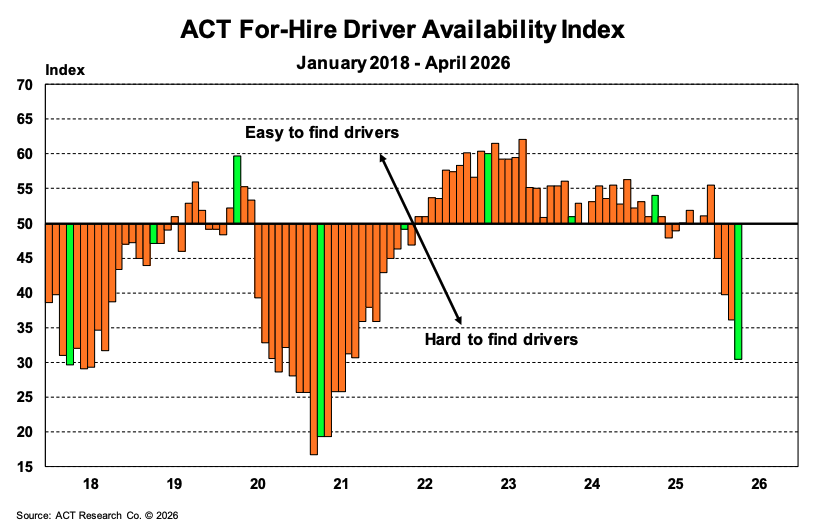
ACT’s For-Hire Trucking Index includes a monthly Driver Availability Index based on survey responses from for-hire trucking service providers.
ACT For-Hire Trucking Index: Driver Availability
This index helps ACT track how fleets are experiencing driver availability in the current market environment. Because the survey sample is weighted toward medium and large truckload and LTL fleets, results may reflect conditions for larger, better-capitalized operators more than the smallest fleets or owner-operators.
Use the Driver Availability Index to understand whether driver conditions are tightening, loosening, or stabilizing — and how those changes may relate to freight demand, spot market conditions, carrier profitability, and capacity.
Why driver shortage headlines often rise near freight inflection points
Driver shortage headlines often become louder when freight demand improves faster than capacity can respond. Fleets can order trucks, recruit drivers, adjust pay, and improve utilization, but those changes take time.
At freight-cycle inflection points, capacity can tighten before the labor market catches up. That is when driver availability becomes a more visible management concern and can contribute to stronger carrier pricing power.
In softer freight markets, the same structural retention challenges remain, but the urgency may fade because freight demand does not require as much seated capacity.
ACT’s view: freight demand determines driver demand
ACT’s view is that freight demand determines the driver population required to move the market’s freight. When freight volumes rise, the market needs more productive seated capacity. When freight volumes fall, fewer drivers may be required in active freight-hauling roles.
This does not mean driver challenges are unimportant. It means they should be evaluated in context: freight demand, carrier profitability, equipment utilization, compensation, quality of life, regulation, and retention all work together to shape driver availability.
Retention is not only a headcount issue. It is also a quality-of-life issue.
Long hours, time away from home, detention time, truck parking shortages, health risks, regulatory requirements, monitoring technologies, and unpaid or underpaid work time all influence whether drivers stay with an employer or remain in the industry.
This is why driver availability cannot be separated from job design, compensation, productivity, and operating conditions. Fleets that improve the driver experience may be better positioned to retain capacity through changing freight cycles.
Economics of Freight & Market Indicators at Work

The Economics of Freight
Understand how freight-generating economic activity connects to Class 8 tractor demand, equipment replacement, carrier profitability, and the broader transportation cycle.

Market Indicators
See how ACT tracks key freight, commercial vehicle, equipment, economic, and survey-based indicators to understand current market conditions and cycle movement.

Explore related freight and driver market resources
Explore related ACT resources to understand freight demand, capacity, driver availability, market indicators, and the broader transportation cycle.
Need deeper freight and driver availability intelligence?
ACT can help you identify the forecasts, reports, survey indexes, data resources, or analyst perspective that fit your planning needs — whether you are evaluating freight demand, capacity, driver availability, equipment utilization, or market-cycle risk.