
Aggregate DAT contract truckload rates were unchanged month-over-month in August at $2.52 per mile, up 18% year-over-year, as tight capacity and new regulatory hurdles continue to shape the U.S. freight market, according to the latest release of ACT’s Freight Forecast: Rate and Volume OUTLOOK report for September 2026. Despite a recent, seasonally impacted, dip in spot rates, net fuel, the market remains supply-constrained, with the ACT Driver Availability Index tightening to 35.9 in August and spot equipment capacity at decade lows.
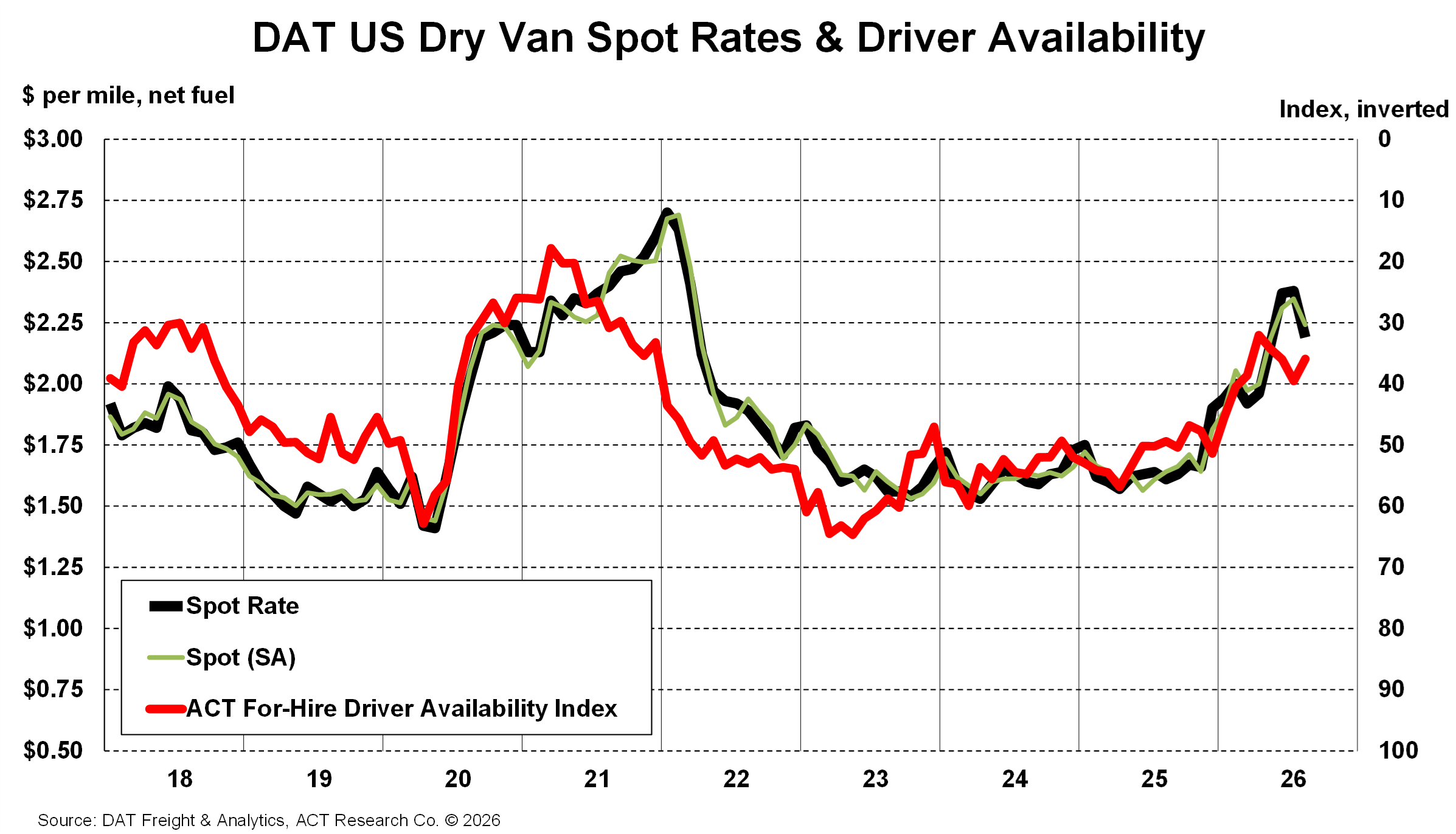
“Tighter capacity and a modest improvement in demand are likely to keep upward pressure on freight rates over the next 12 to 18 months,” said Tim Denoyer, ACT Research’s Vice President and Senior Analyst. “New broker liability laws and FMCSA driver regulations are raising barriers to entry, and while Class 8 tractor production is increasing, fleet growth will remain slow as replacement demand and elevated exports limit expansion.”
“While the recent $120 billion in tariff refunds may provide a temporary boost to freight demand and support the long-awaited inventory restock, the underlying supply constraints remain the primary drivers of current market dynamics,” Denoyer continued. “With contract rates now offering a significant cost advantage over private fleets and ongoing regulatory changes ahead, we expect the ‘stronger for longer’ for-hire rate cycle to persist, even as risks from rising fuel prices and interest rates remain elevated.”
Freight Forecast Report Overview
AThe monthly 58-page ACT freight forecast provides analysis and forecasts for a broad range of U.S. freight measures, including the Cass Freight Index, Cass Truckload Linehaul Index, and DAT spot and contract rates by trailer type. The service provides monthly, quarterly, and annual predictions for the TL, LTL, and intermodal markets over a two- to three-year time horizon, including capacity, volumes, and rates. The Freight Forecast provides unmatched detail on the freight rate outlook, helping companies across the supply chain plan with greater visibility and less uncertainty.
ACT Research Overview
ACT Research is recognized as the leading publisher of commercial vehicle truck, trailer, and bus industry data, market analysis and forecasts for the North America and China markets. ACT’s analytical services are used by all major North American truck and trailer manufacturers and their suppliers, as well as banking and investment companies. ACT Research is a contributor to the Blue Chip Economic Indicators and a member of the Wall Street Journal Economic Forecast Panel. ACT Research executives have received peer recognition, including election to the Board of Directors of the National Association for Business Economics, appointment as Consulting Economist to the National Private Truck Council, and the Lawrence R. Klein Award for Blue Chip Economic Indicators’ Most Accurate Economic Forecast over a four-year period. ACT Research senior staff members have earned accolades including Chicago Federal Reserve Automotive Outlook Symposium Best Overall Forecast, Wall Street Journal Top Economic Outlook, and USA Today Top 10 Economic Forecasters. More information can be found at www.actresearch.net.
Additional Resources
Tighter supply remains the main reason for accelerating rates, as discussed in the latest release of the Freight Forecast: Rate and Volume OUTLOOK report.
“The volume recovery seems delayed by a hopefully brief bout of inflation, and it will take time for the razor thin US savings rate to recover,” said Tim Denoyer, ACT Research’s Vice President and Senior Analyst. “But fuel prices are falling, tariffs are lower, inventories are tight, and import trends are improving, so a modest freight demand recovery remains likely later this year. But tighter supply is still the main driver of accelerating rates, and a lull in spot rate trends after the recent surge seems likely near term.”
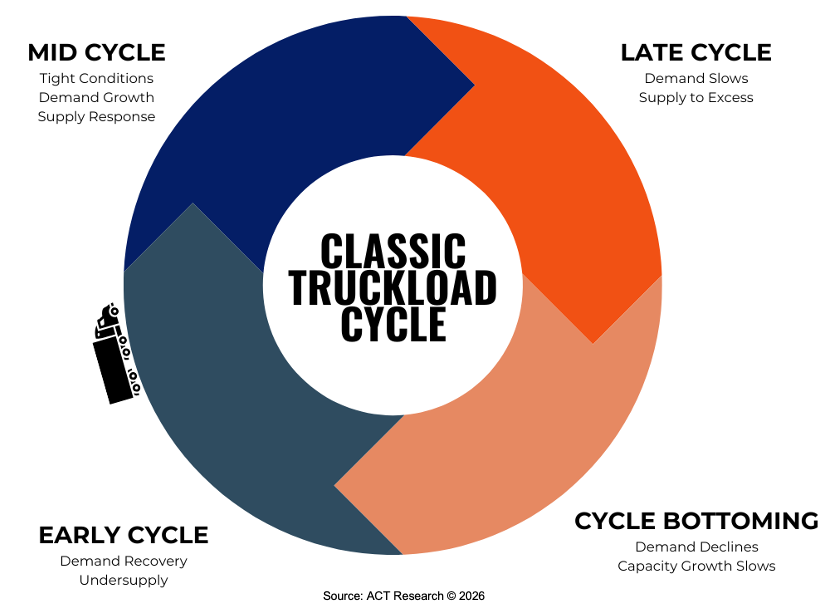
“The early cycle phase of the classic truckload market cycle, where the industry is today, is usually supply-led. Volumes still don’t look great, but the industry is heading towards the mid-cycle phase, with improving volume trends on the way. With truckload capacity pinched, the domestic intermodal market is in an unusual position of seeing that demand first,” Denoyer concluded.
Click here to learn more information about ACT's most subscribed report.
ACT Research is featured regularly by major news outlets for our work covering Class 8 truck orders, sales, forecasting, used truck sales, freight rates, trailer sales, and much more. Get more trends, HERE.

