
Driver availability has returned to the center of the freight-market conversation, but understanding its effect requires looking beyond the total number of licensed drivers.
In its recent white paper, Structural Forces Reshaping the Freight Market, J.B. Hunt examined how regulatory enforcement, pressure on the qualified-driver pool, and rising carrier operating costs are changing the supply of available freight capacity. As discussed in depth in the ACT Freight Forecast, the paper argues that these forces could affect transportation budgets, sourcing strategies, and carrier relationships even if freight demand remains relatively measured.
The current freight-market tightening is not primarily the result of a broad demand surge. It is increasingly a question of how much qualified, compliant, and economically sustainable capacity is available to move the freight already in the market.
Three Forces Shaping the Market
J.B. Hunt organizes its analysis around three connected pressures.
First, increased regulatory enforcement is affecting the available carrier and driver pool. The paper examines non-domiciled CDL requirements, English-language proficiency enforcement, cabotage restrictions, electronic logging device compliance, driver-training oversight, and carrier-vetting practices. In addition to regulatory forces constraining supply, we would add unfavorable domestic demographics as a long-term secular headwind.
Second, fleets are facing greater competition for qualified drivers. Hiring new drivers is only part of the challenge. Carriers must also retain existing drivers, provide competitive compensation, manage working conditions, and productively utilize drivers in available equipment.
Third, carriers continue to absorb higher insurance, equipment, maintenance, and labor expenses. J.B. Hunt cites data from the American Transportation Research Institute showing that average trucking operating costs reached a record $2.336 per mile, including fuel, in 2025—an increase of 3.4% from 2024. Excluding fuel, operating costs increased 4.2% to $1.854 per mile.
The paper’s broader conclusion is that transportation pricing established during an extended period of excess capacity may not be sufficient to support safe, reliable, and economically sustainable capacity over the next market cycle.
What are the implications of these pressures? Transportation plans built around the conditions of the previous downcycle may require more frequent review as qualified capacity becomes less flexible.
How J.B. Hunt Used ACT’s For-Hire Trucking Index
Within its discussion of the qualified-driver pool, J.B. Hunt references the ACT For-Hire Trucking Index and reproduces ACT’s Driver Availability Index covering January 2019 through June 2026.
J.B. Hunt uses the index as evidence that fleets experienced rapidly tightening driver availability during the first half of 2026. The chart is attributed to ACT Research’s July 2026 For-Hire Trucking Index.
ACT’s For-Hire Trucking Index is based on monthly survey responses from for-hire carriers. It tracks directional changes across freight volumes, rates, fleet capacity, driver availability, equipment-purchasing intentions, and broader supply-and-demand conditions.
The driver shortage moderated in July, as ACT’s Driver Availability Index rose to 38.5 in July, from 34.4 in June, after reaching a five-year low of 30.4 in April. In this diffusion index, readings below 50 indicate contracting driver availability. “Less bad” improvements in the past few months suggested that the pace of contraction was beginning to stabilize.
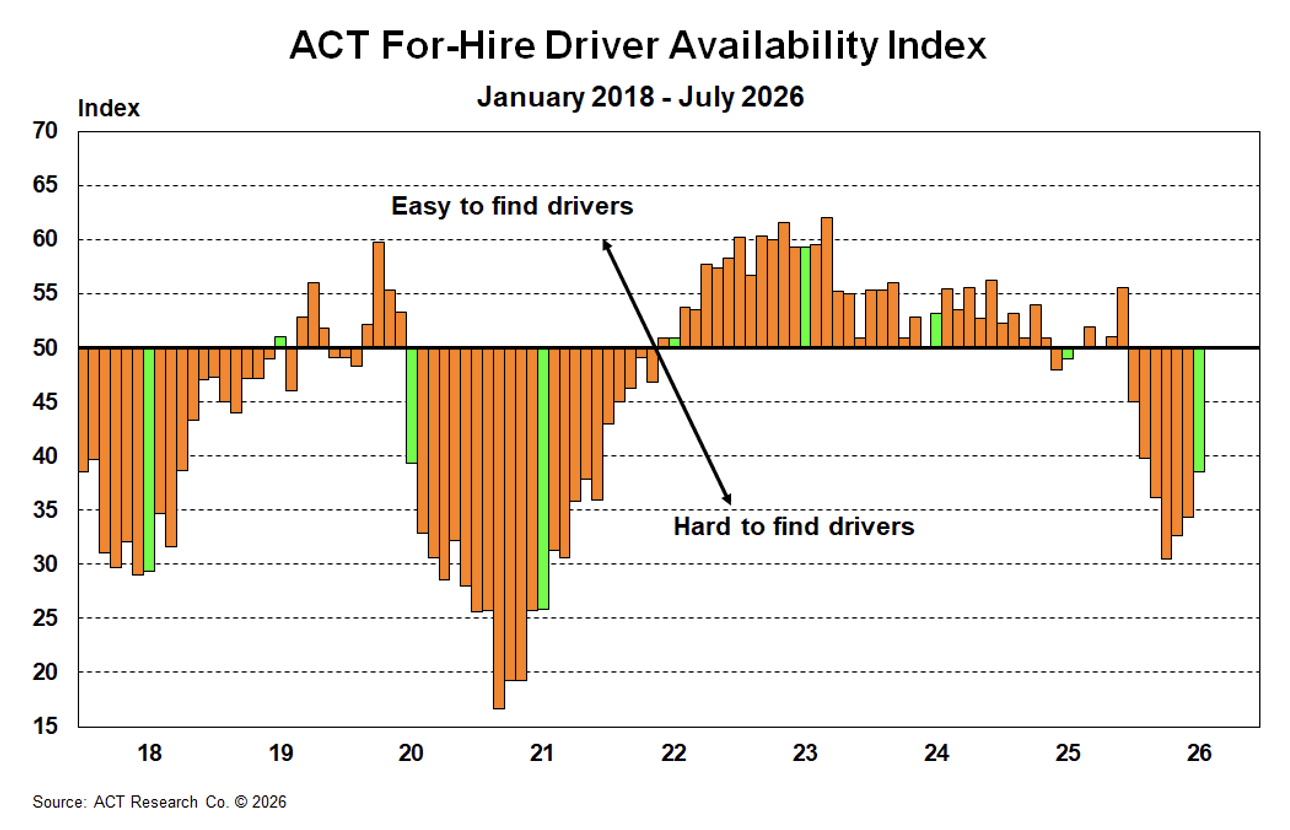
Along with other metrics in the For-Hire survey, the driver availability question gives ACT a direct view into how participating fleets are experiencing the market. It does not estimate the theoretical number of drivers available, but it does help identify whether carriers are finding it easier or harder to find the qualified drivers needed to meet current freight requirements.
ACT’s View: Driver Constraints Are Real, but They Are Also Cyclical
Historically, ACT has not viewed the driver market as one in permanent, universal shortage. Driver availability tightens and loosens with the freight cycle. Understanding the signals leading that cycle can help carriers, shippers, and other transportation stakeholders anticipate changes in driver demand and effective capacity.
Driver conditions vary across long-haul truckload, private fleets, LTL, vocational operations, and other trucking segments. Compensation, home time, job quality, safety, lifestyle, management practices, regulatory requirements, and alternative employment opportunities all influence recruitment and retention.
The number of drivers the industry requires also changes with freight demand. When freight volumes rise, fleets need more productive seated capacity, and competition for drivers increases. When freight demand weakens, the market may require fewer active drivers even though the industry’s underlying retention and job-quality challenges remain.
In the current cycle, enforcement of logging rules that had long been broken has also reduced capacity, reducing driver availability. And the Supreme Court’s Montgomery ruling, which increased broker liability, has further increased barriers to entry for new drivers.
For that reason, the term “driver shortage” can oversimplify the situation. The more useful questions are:
- How many qualified drivers does the market require at the current level of freight demand?
- How successfully can fleets recruit, retain, and productively seat those drivers when freight conditions require capacity increases?
- How are compensation and working conditions affecting the supply response?
- How much potential capacity is being constrained by regulation, equipment availability, or carrier economics?
- How quickly can driver and equipment supply respond if freight demand strengthens?
ACT’s latest freight-market commentary indicates that driver availability has begun to stabilize, if at tight levels, as higher pay attracts drivers and freight demand softens seasonally. However, regulatory constraints, a smaller Class 8 tractor fleet, and limited equipment availability continue to restrict the market’s ability to add capacity quickly. ACT therefore continues to characterize the current freight cycle as early-stage and supply-driven.
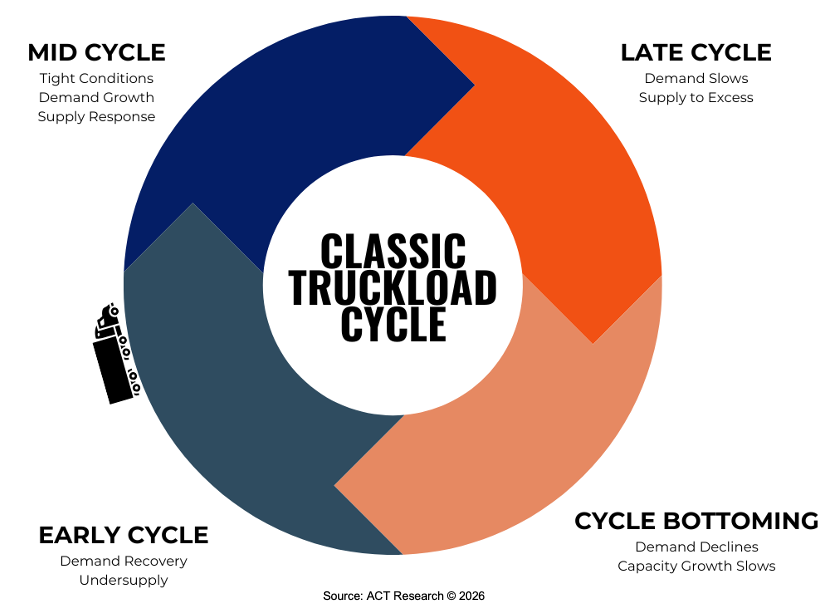
This cycle may differ from previous cycles because regulatory enforcement, competition for qualified drivers, and elevated carrier operating costs are converging. Stronger enforcement may improve the quality and compliance of the available driver and carrier pool while also removing capacity from the market. At the same time, greater competition and improving rates may encourage innovation in recruiting, retention, compensation, productivity/utilization, and the driver experience.
The effects will not be uniform. The fleets best positioned to capitalize will likely be those that can recruit and retain qualified drivers, improve equipment utilization, manage elevated operating costs, and identify where freight demand can support profitable capacity.
What This Means for Transportation Planning
For shippers, a supply-driven market recovery can create cost and service pressure before a conventional demand boom appears.
For carriers, improving rates may support better driver compensation and retention, but higher insurance, equipment, financing, and maintenance costs will continue to weigh on profitability.
For brokers and 3PLs, carrier qualification and capacity quality may become increasingly important.
J.B. Hunt’s use of ACT’s Driver Availability Index demonstrates why independent market intelligence matters. Driver availability is not an isolated labor statistic. It is part of the freight-capacity equation, connecting freight volumes, regulation, compensation, carrier profitability, freight rates, equipment utilization, and the market’s ability to respond to changing demand.
ACT’s For-Hire Trucking Index and Freight Forecast help transportation leaders track those relationships and evaluate how changes in driver availability may affect rates, capacity, equipment investment, and planning decisions.
ACT is continuing to expand its analysis of the commercial driver market, connecting driver availability, compensation, retention, regulation, freight demand, and equipment capacity. Additional research will be introduced later this year.